Show Notes
Welcome back. Today we’re doing a midyear market check-in for long-term investors: what has happened so far in 2026, why markets have been stronger than many expected, and what investors should watch as we move through the second half of the year.
In a few weeks, I’ll be sharing my quarterly webinar with my email subscribers. So if you want a full rundown of what’s been going on recently and what I’m thinking about going forward, sign up for my newsletter here.
Sign up for my newsletter so you can easily reply to my emails with your thoughts or questions for the podcast:
U.S. Stocks in 2026: AI Earnings Growth Is Driving the Rally
Let’s start with U.S. stocks.
U.S. stocks are up about 10% year-to-date, which might surprise people given the Iran war, the effective closing of the Strait of Hormuz, and the impact those events have had on energy prices. But the reason stocks have held up is pretty straightforward: earnings have been stronger than expected.
A lot of that earnings growth is coming from companies tied to the AI buildout. The chart below from Vanguard compares earnings growth across all companies, the hyperscalers, the rest of the AI complex, and non-AI-related companies.
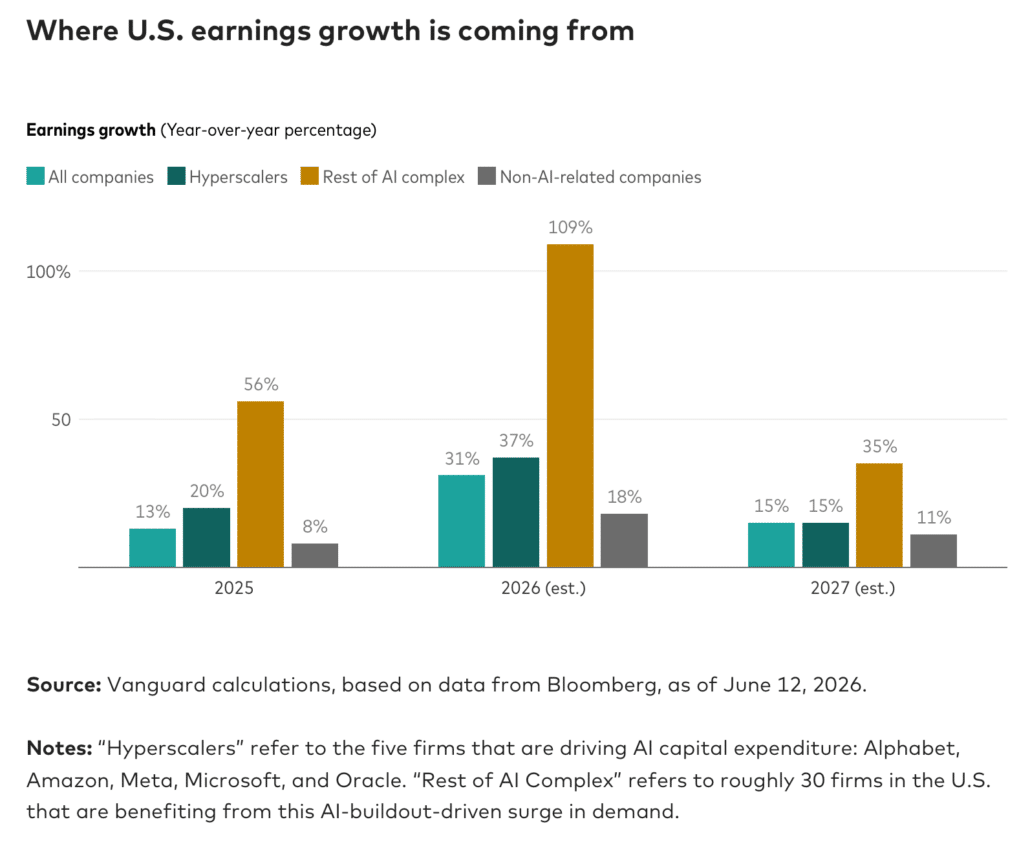
The broader AI complex—companies benefiting from demand for chips, data centers, networks, and other AI infrastructure—is expected to grow earnings by 109% in 2026. That compares with 31% for all companies and 18% for non-AI-related companies.
Schwab’s U.S. outlook tells a similar story, but also points out that only about 17% of S&P 500 stocks outperformed the index over the prior month, one of the lowest readings in the past decade. That is the key tension in the U.S. market right now. The index looks strong, and the earnings growth is real. But a relatively small group of companies and sectors is doing a lot of the heavy lifting.
The AI story also comes with a capital-spending question, with the largest hyperscalers will spend nearly $800 billion on capital expenditures this year and more than $900 billion in 2027. That spending supports earnings across the AI supply chain, but it also raises the bar. Investors eventually need to see that these investments produce durable profits, productivity gains, and cash flow.
So the question is not whether AI matters. It clearly does. The question is whether expectations have moved so high that there is less room for disappointment.
Wall Street vs. Main Street: Why Strong Markets Don’t Always Feel Like a Strong Economy
This also helps explain the disconnect between Wall Street and Main Street.
On one side, business investment is strong thanks to build out in AI infrastructure. On the other side, many consumers are still under pressure. Consumers are dealing with negative real wage growth, weak savings, and rising energy costs. The labor market looks relatively stable at the headline level, so it’s not necessarily a headwind for the consumer but it also isn’t necessarily a source of strength.
One other data point from Federal Reserve data that stood out to me recently is that equities now represent more than 47% of household financial assets, nearly triple the level near the 2008 financial crisis low.
What that says to me is that a meaningful stock market correction could affect confidence and spending, too.
International Diversification in 2026: Developed Markets, Emerging Markets, and the AI Supply Chain
Beyond the U.S., international diversification continues to be important because different parts of the world have different sector exposures, different economic drivers, and different risks.
Developed international, as measured by the MSCI EAFE, has its largest country exposures in Japan, the United Kingdom, France, Switzerland, and Germany. Its largest sector weights are financials and industrials, while information technology is just over 11%. That can help diversify a portfolio, but it also means developed international markets have not had the same direct AI tailwind as the U.S. or parts of Asia.
Year- to-date, developed international markets (as measured by the MSCI World ex USA Index) are up a little more than 9%, so fairly similar to U.S. markets, but they’ve generally benefited less from AI infrastructure build out and been more exposed to the economic effects of the energy shock.
Emerging markets, on the other hand, has been a big winner of the AI and energy story as the MSCI Emerging Markets Index gaining nearly 24% through June 30.
The real driver has been a small group of semiconductor companies tied to global AI capital spending. Taiwan Semiconductor Manufacturing, Samsung Electronics, and SK Hynix represent slightly more than one-quarter of the MSCI Emerging Markets Index, but account for about half of expected 2026 earnings growth. Technology earnings are expected to grow 159% and represent 58% of overall emerging-market earnings growth.
Energy and materials are also important. Higher commodity prices tied to the Iran war and the AI infrastructure buildout are expected to support earnings growth for materials and energy companies; and technology, materials, and energy combined represent roughly 80% of expected 2026 earnings growth for the emerging-markets index.
For long-term investors, the lesson is not to chase emerging markets after a strong run. Global diversification still matters, and it’s important to maintain strategic, long-term allocations rather than chasing markets or headlines.
Bond Market Outlook: Interest Rates, Inflation, and Fixed Income Strategy
In the bond market, interest rates generally have increased this year, but fixed income returns have been positive.
For much of the past few years, investors have been waiting for the Federal Reserve to cut rates. But inflation remains sticky and the Fed appears likely to stay patient, so many forecasts expect the 10-year Treasury yield to remain mostly in a 4% to 4.5% range in the near term, with more risk to the upside than the downside.
For long-term investors, the role bonds play is the portfolio ballast. That being said, this feels like best fixed income has looked since before the Financial Crisis. That’s in part because of current yields, but also because of the tremendous improvement in the types of products available for accessing fixed income markets.
I’ve done a variety of episodes in the past on fixed income that I will link to in the show notes, but I’ll just say that if you’re holding individual bonds rather than bond funds OR utilizing index funds in your fixed income portfolio, I think it’s time to better familiarize yourself with the research and product landscape, or consider hiring an advisor.
EP.99 – The Problem With Investing in Bond Indexes
EP.223 – Bond Funds vs. Individual Bonds: What’s Best For Your Portfolio
EP.235 – Why Your Bond Questions Are Really About Cash
Second-Half 2026 Market Outlook: What Long-Term Investors Should Watch
So what should long-term investors expect from here?
I’m not really one for making predictions. I believe in building a diversified portfolio based on a financial plan that accounts for thousands of possible scenarios.
But as someone that enjoys watching markets, there are a few things I’m interested in seeing playing out:
- Does earnings growth broaden beyond AI and energy-linked sectors?
- Does AI spending turns into durable returns?
- Will energy prices keep inflation elevated?
- How high can bond yields move high before pressuring stock valuations?
For long-term investors, my takeaway will always be to stay disciplined.
That means maintaining a diversified portfolio across sectors, regions, and asset classes. It means rebalancing when a portfolio becomes too concentrated. And it means letting your financial plan dictate the mix of stocks, bonds, and cash that will keep short-term market swings from forcing long-term decisions.
Just remember, for long-term investors, the job is not to predict every headline. The job is to participate in growth, manage concentration, stay diversified globally, and avoid letting short-term volatility derail a long-term plan.
Thanks for listening, and we’ll see you next time.
Resources:
- EP.99 – The Problem With Investing in Bond Indexes
- EP.223 – Bond Funds vs. Individual Bonds: What’s Best For Your Portfolio
- EP.235 – Why Your Bond Questions Are Really About Cash
The Long Term Investor audio is edited by the team at The Podcast Consultant
Submit Your Question For the Podcast
Do you have a financial or investing question you want answered? Submit your question through the “Ask Me Anything” form at the bottom of my podcast page.
Support the Show
Thank you for being a listener to The Long Term Investor Podcast. If you’d like to help spread the word and help other listeners find the show, please click here to leave a review.
I read every single one and appreciate you taking the time to let me know what you think.
Disclosure: This content, which contains security-related opinions and/or information, is provided for informational purposes only and should not be relied upon in any manner as professional advice, or an endorsement of any practices, products or services. There can be no guarantees or assurances that the views expressed here will be applicable for any particular facts or circumstances, and should not be relied upon in any manner. You should consult your own advisers as to legal, business, tax, and other related matters concerning any investment.
The commentary in this “post” (including any related blog, podcasts, videos, and social media) reflects the personal opinions, viewpoints, and analyses of the Plancorp LLC employees providing such comments, and should not be regarded the views of Plancorp LLC. or its respective affiliates or as a description of advisory services provided by Plancorp LLC or performance returns of any Plancorp LLC client.
References to any securities or digital assets, or performance data, are for illustrative purposes only and do not constitute an investment recommendation or offer to provide investment advisory services. Charts and graphs provided within are for informational purposes solely and should not be relied upon when making any investment decision. Past performance is not indicative of future results. The content speaks only as of the date indicated. Any projections, estimates, forecasts, targets, prospects, and/or opinions expressed in these materials are subject to change without notice and may differ or be contrary to opinions expressed by others.
Please see disclosures here.