Show Notes
In this episode, we’re talking about one of the biggest questions parents and grandparents face when saving for a child: how much of that money should actually go into a 529 plan?
Because 529 plans are powerful. But some families also worry about overfunding the account, locking up too much money, and finding out later that their child got a scholarship, chose a less expensive path, or didn’t need all of it for school after all. And while the newer 529-to-Roth IRA rollover rules help, those rules don’t make it an obvious choice to pour every dollar you can into a 529. Instead, I think parents and grandparents need to think more intentionally about what job each account is supposed to do.
And before we get into it, feel free to click on the image below to download my companion guide: “Can I Make a 529-to-Roth IRA Transfer?”
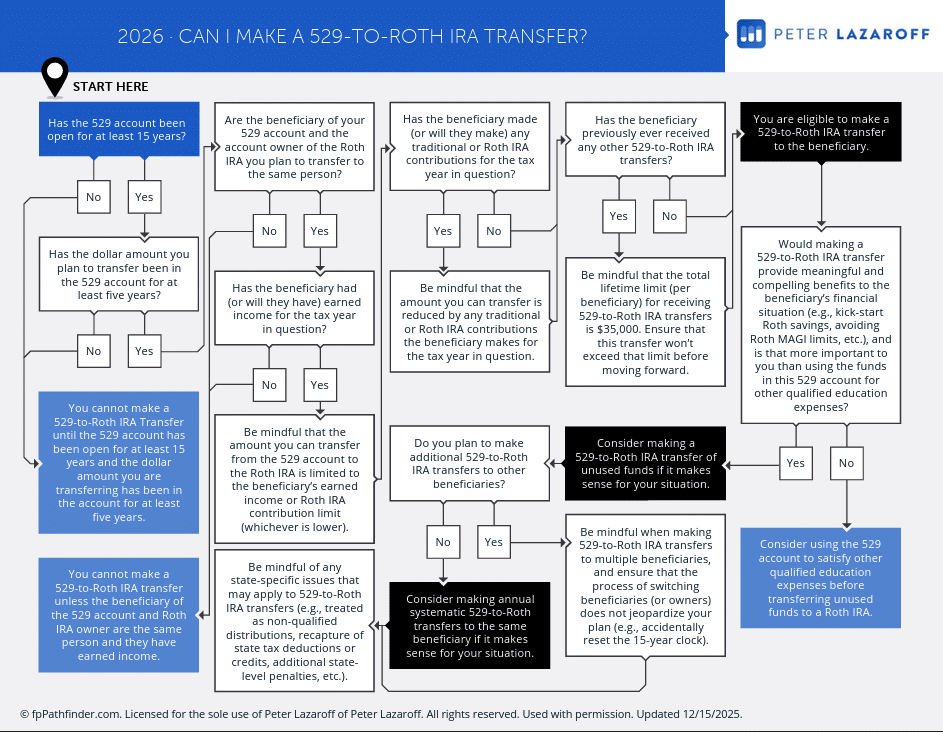
Hopefully this gives you a simple framework for deciding whether this strategy may apply to your family and whether those dollars may be better used elsewhere first.
Sign up for my newsletter so you can easily reply to my emails with your thoughts or questions for the podcast:
Why 529 Plans Are Still the Default Starting Point
Let’s start with what 529 plans do well.
A 529 plan is one of the best tools we have for education savings because the earnings grow free of federal tax, and withdrawals are tax-free when used for qualified education expenses. Depending on where you live, your state may also offer a deduction or credit for contributions. Just as important, the account owner keeps control of the assets, and the beneficiary can often be changed to another family member if plans change. That combination of tax benefits, control, and flexibility is hard to beat.
From an investment standpoint, most plans make this pretty easy. If you’re a busy parent or grandparent, age-based portfolios are often a perfectly reasonable default. They typically start with more stock exposure when the child is young and gradually become more conservative as college gets closer. It’s not complicated, and that’s part of the appeal.
How Much Should You Actually Put in a 529?
This is where I think a lot of people get tripped up.
The tax code allows you to put a lot of money into a 529. Contributions can have gift-tax consequences if they exceed the annual exclusion amount, but there is also a special rule that lets you front-load up to five years’ worth of annual exclusion gifts into a 529 and spread them ratably for gift-tax purposes. In other words, the system gives families room to fund these accounts aggressively.
But just because you can contribute that much doesn’t mean you should.
In practice, I think many families are better off treating a 529 as a tool for funding a meaningful portion of future education costs, not necessarily every last dollar.
If your goal is to be really helpful without boxing yourself in, aiming to cover maybe 60% to 70% of expected tuition can be a reasonable target. That leaves room for changing circumstances or the reality that your child may not follow the exact path you pictured when they were three years old.
And I also want to repeat something I’ve said before: don’t prioritize your child’s education savings over your own financial well-being. Kids can borrow for school. You can’t borrow for retirement. I’m pretty sure that if my kids had to choose between taking out some student loans or having me live in their basement in retirement, they’d choose to fund their own education.
The Biggest 529 Fear: What If You Save Too Much?
That gets us to the emotional heart of the issue.
Education planning is a long-distance decision made with incomplete information. When your child is young, you don’t know whether they’ll earn a scholarship, attend a lower-cost school, go to graduate school, pursue a trade, or leave money unused. And for a long time, that uncertainty created a real psychological barrier: what if I overfund this account and trap money in the wrong place? Nonqualified withdrawals generally trigger ordinary income tax on the earnings portion plus a 10% additional tax on those earnings.
The good news is that 529s have always been fairly flexible. You may still be able to use the money for other qualified education expenses. You may be able to change the beneficiary to another family member. And now, in certain cases, unused 529 dollars can also be moved into a Roth IRA for the beneficiary.
Why the 529-to-Roth Rule Helps
That Roth rollover rule is relatively new and something everyone seems to notice, and I understand why. It sounds like a big deal.
But this is not a loophole for supercharging retirement savings through a 529. It’s a limited safety valve for modest overfunding. The rules are tight by design, and that’s exactly why I think this change is so helpful. It reduces the fear of making a reasonable mistake without turning a 529 into a stealth retirement account.
The Rollover Rules in Plain English
The easiest way to understand the rules is to break them into three buckets: who can do it, when they can do it, and how much they can do.
First, who can do it. The Roth IRA has to belong to the same person who is the 529 beneficiary, and that beneficiary needs enough earned income in the year of the rollover to support the amount moved.
Second, when can they do it. The 529 account generally has to have been open for at least 15 years, and the dollars being moved generally have to come from contributions and earnings that have been in the account more than five years. The transfer also has to be done directly from the 529 to the Roth IRA custodian. You cannot take possession of the money yourself and then try to redeposit it later.
Third, how much can they do. The rollover counts toward the beneficiary’s annual IRA contribution limit for that year, which means any other traditional or Roth IRA contribution they make uses up part of the room. There is also a lifetime cap of $35,000 per beneficiary. So in practice, this usually means a series of annual transfers over multiple years, not one big move. Beginning in 2026, the IRA contribution limit is $7,500, which shows you how this would usually play out over time.
Save with the Goal, Not the Roth Opportunity
Now here’s the most important part.
I do not think you should begin with the Roth rollover. You should begin with the original goal. Before you start mentally converting education savings into retirement savings, ask whether the money is still likely to be used for education, whether another family member could use it, and whether you’re overlooking legitimate qualified education expenses.
This is part of why I think the PDF flowchart in the show notes and at the top of the episode description is so useful—it pushes you to ask those questions before making the transfer.
But if the education need is truly behind you, and the beneficiary has earned income, then the rollover can be genuinely valuable. Giving a young adult an early Roth balance matters. Not because $35,000 solves retirement by itself. It doesn’t. But because starting early matters, and this rule gives families a way to redirect otherwise stranded education money into a long-term asset without creating an unnecessary tax hit. That’s a meaningful improvement.
A Few Important Cautions
There are still a couple of reasons not to get too cute with this.
First, federal tax treatment and state tax treatment are not always the same. Some states may recapture prior deductions or credits or otherwise treat the rollover differently. Second, there are still unresolved questions around how beneficiary changes interact with the 15-year rule. So if your plan involves changing beneficiaries mainly to create rollover eligibility, slow down and get tax advice before acting. This is one of those areas where being technically close is not the same as being safely correct.
The Bigger Lesson: Not Every Dollar Should Go Into a 529
And I think that leads to the real planning takeaway.
The answer to overfunding risk is not always avoiding 529s. More often, it’s simply avoiding the temptation to put every dollar for a child into one kind of account.
That’s where custodial accounts can be useful.
A custodial account, usually a UGMA or UTMA account, is not a tax-advantaged education account like a 529. It’s an investment account owned by the child, with an adult serving as custodian until the child reaches the age of majority under state law. That means it doesn’t offer the same education-specific tax benefits or beneficiary flexibility as a 529. But it does offer broader flexibility. The money can generally be invested in a wider range of options, and while the child is still a minor, it can be used for the child’s benefit without having to fit inside the narrower definition of qualified education expenses.
And that’s why I think custodial accounts can be a little underrated. Not because they’re better than 529 plans. Usually they aren’t. But because they can serve a different purpose. A 529 is often the better tool for core education funding. A custodial account can be a useful sidecar account for the gray-area expenses that tend to pop up around the college years, or for families who want some money set aside for a child without locking every dollar into an education-only bucket.
The Tradeoffs Matter
Of course, that flexibility comes with tradeoffs.
The gift to the child is irrevocable. You generally can’t change the beneficiary the way you can with a 529. Once the child reaches the age of majority, the account becomes theirs to control. They may use it for college. They may not. Custodial accounts can also be less favorable in financial aid calculations because UGMA and UTMA accounts are treated as the student’s assets on the FAFSA, while a parent-owned 529 is reported with parent investments for a dependent student.
And from a tax standpoint, investment income in custodial accounts can run into kiddie-tax rules. In 2026, the first $1,350 of unearned income is generally exempt from federal income tax, the next $1,350 is generally taxed at the child’s rate, and amounts above $2,700 can be taxed at the parents’ rate.
The Bottom Line
If your goal is saving for qualified education expenses, a 529 plan is still usually the first place I’d look. The tax treatment is hard to beat, the owner keeps control, the beneficiary rules are flexible, and the newer Roth rollover provision makes the account easier to use without feeling quite so boxed in.
But I wouldn’t necessarily max out a 529 just because the rules allow it. I think the better lesson is to match the account to the job.
Use a 529 for core education savings.
Treat the 529-to-Roth rollover as a backup valve, not the goal.
And use a custodial account when flexibility matters and you don’t want every dollar for a child locked into an education-only bucket.
Resources:
- Can I Make A 529-to-Roth Transfer?
- Common Savings Accounts for Children
- Trump Accounts: What Parents Should Actually Care About
The Long Term Investor audio is edited by the team at The Podcast Consultant
Submit Your Question For the Podcast
Do you have a financial or investing question you want answered? Submit your question through the “Ask Me Anything” form at the bottom of my podcast page.
Support the Show
Thank you for being a listener to The Long Term Investor Podcast. If you’d like to help spread the word and help other listeners find the show, please click here to leave a review.
I read every single one and appreciate you taking the time to let me know what you think.
Disclosure: This content, which contains security-related opinions and/or information, is provided for informational purposes only and should not be relied upon in any manner as professional advice, or an endorsement of any practices, products or services. There can be no guarantees or assurances that the views expressed here will be applicable for any particular facts or circumstances, and should not be relied upon in any manner. You should consult your own advisers as to legal, business, tax, and other related matters concerning any investment.
The commentary in this “post” (including any related blog, podcasts, videos, and social media) reflects the personal opinions, viewpoints, and analyses of the Plancorp LLC employees providing such comments, and should not be regarded the views of Plancorp LLC. or its respective affiliates or as a description of advisory services provided by Plancorp LLC or performance returns of any Plancorp LLC client.
References to any securities or digital assets, or performance data, are for illustrative purposes only and do not constitute an investment recommendation or offer to provide investment advisory services. Charts and graphs provided within are for informational purposes solely and should not be relied upon when making any investment decision. Past performance is not indicative of future results. The content speaks only as of the date indicated. Any projections, estimates, forecasts, targets, prospects, and/or opinions expressed in these materials are subject to change without notice and may differ or be contrary to opinions expressed by others.
Please see disclosures here.